Companies are rushing to invest in and pursue initiatives that use Big Data Analytics. “Data” has become the new resource that every company worth its salt is trying to mine to either transform its business (e.g. to reduced operating cost) and/or deliver added ‘value’ to its customers (e.g. improved customer experience). Research has shown that nearly eight out of ten organizations have big data projects underway, but only 27% describe their efforts as “successful,” and a scant 8% as “very successful.”
Data Analytics implementation fails to deliver when companies simply jump into ‘analyzing’ data, when they realize they have ton of unutilized data they need to analyze or when they notice they are lagging competition on embracing analytics. They often attribute failed implementation to one or more the following factors- lack of data, lack of skilled manpower, lack of leadership engagement etc.
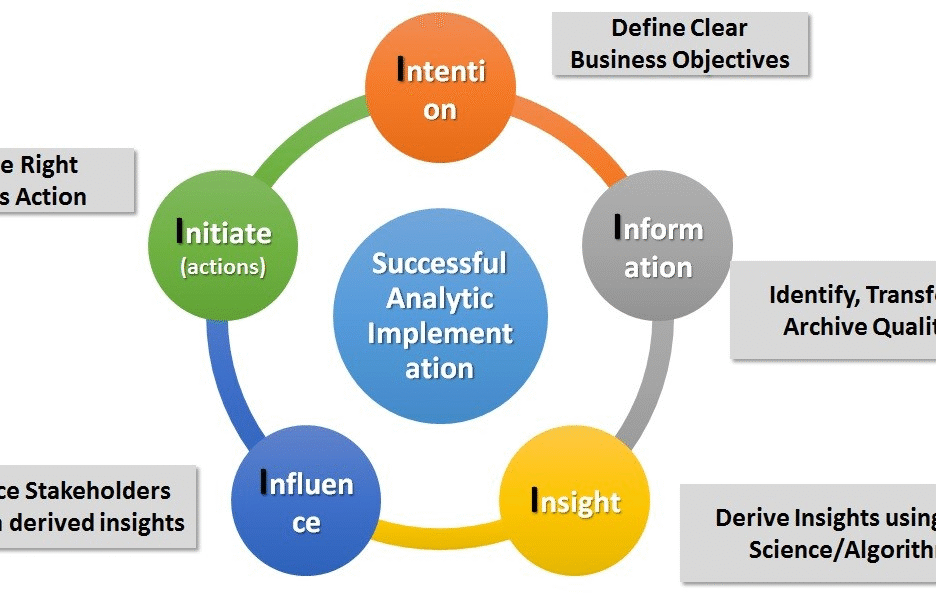
Using data analytics to take business action needs a structured approach along with a ‘mindset’ change of the employees. Organizations can follow this 5I framework to start for successful implementation of their data analytic strategy. Leaders who have successfully implemented data analytic strategy are seen to follow this 5I model.
5I framework sets the journey for successful implementation. This can be described as a 2-D grid – with each additional “I” you tackle, you consume more time and organizational resource.
First I (INTENTION)
Quite often organization jump into analytics on realizing they have a bunch of unutilized data or driven by peer/competitive pressure. They start their analytics journey by asking ; “can you show me or tell me what can you infer from this data?”. This would constitute an ineffective start.
We need to start their analytics journey by asking the right question or clarifying the business “Intention” behind doing Analytics. Question should be informational but actionable. They should be forward looking, practical and asking tough business questions. They should lay the ground work to accomplish company’s strategic objectives and relate to key performance indicators of KPI’s
Some questions can be:
· Which customer segments are most profitable?
How to improve marketing campaign response?
· Which customers are most likely to upgrade?
· How do the products need to be bundled?
· Which customers are most likely to leave?
These questions are definitive and much better than “show me” or “tell me” type of questions
Second I (INFORMATION)
Once we are clear on our intention, we need to start looking for data required. In this step one needs to find out how much structured, unstructured data is available, what is the cost to collect additional data if required. If the intention is to reduce freight cost and delivery time in fulfilling the orders for supply chain, the data that would be required are tonnage, cost, invoice, customer location etc. But is that enough? Do we have information on whether the order was fulfilled by one shipment or multiple shipment? Do we have the ZIP code of the customers which would allow to calculate the distance travelled to fullfill the orders? Often 80 % of the required data lies in unstructured form (pdf files, Wapp messages, comments in forms etc). In this stage, time and effort needs to be devoted to collect such data, transform, archive and store them into a form (e.g. data tables, warehouse, marts, lakes etc.) that can be analyzed by computer program. If we start deriving insights without going through this stage, the results will be half baked and business champions will soon lose interest in sponsoring the analytics efforts.
Third I (INSIGHTS)
Once data/information is in place, we step into the next phase of developing and applying analytic algorithms (including machine learning) for deriving “insights. We need to ask whether the Insights for questions in First I can be answered using supervised, unsupervised or reinforcement/reward algorithms.
Which technology, platform, skills sets need to be used should be clarified in this stage. Another important activity of this step is to extract features from the data. Feature Engineering or Feature Extraction describes the structures inherent in your data.. In computer vision, an image is an observation, but a feature could be a line in the image. In natural language processing, a document or a tweet could be an observation, and a phrase or word count could be a feature. In speech recognition, an utterance could be an observation, but a feature might be a single word or phoneme. Depending on Intention and features available one can use one or more of the following algorithms to extract Insights. Refer pic below.
Fourth I (INFLUENCE)
This is often the most overlooked step that leads to failure of Big Data analytics projects. The results from “Insight” step need to be contextualized with respect to business needs, and the stakeholders must be influenced into acting upon those insights. The key decision makers would like to see ‘what-is-in-it-for-me/organization”, how the solution would scale, what would be cost of implementation, how much IP would be generated and how long it will take to get the results etc. The results from the “Insights” should be smartly used to influence and get buy-in from these decision makers. Only when they are on-board, they will support the analytic implementation with organizational resources, and remove implementation bottlenecks including political barriers. You need to lobby, push, persuade your key decision makers so they see a value in your” insights” or preliminary results. If the effort requires hiring data scientist, this needs to be highlighted in the stage. If the key stakeholders are not favorably influenced, then the algorithms stays as a small POC code/notebook or gets published in some technical paper (conference/journal) and never sees the light of the day.
Fifth I (INITIATE)
Once you have use the “Insights” to “Influence” the Stakeholders, and obtained the organizational resources, it is time to “Initiate” the action on the ground. You have created the right setting to implement analytics solution in your organization; it is time to start acting on them now. You can launch special market campaign to target a specific customer segment or you can launch some loyalty program to retain your ‘valued’ customer. This entire process can be managed as a project or a series of projects.
Summary – To successfully implement the data analytic solution in your function or organization, you need to keep an eye on each of the 5 I’s. You need to ask whether you have spent necessary time and focus in each of these steps before moving on in your journey. And if you have followed the 5 I’s, you would be much better placed to achieve your “Intention/s” that you had envisaged at the beginning in the first I of the analytic journey. Be rest assured, when you are surveyed by analytic pundits, you will now have more positive stories to tell on why you succeeded in your implementation and not why you failed.
Note- This is my personal view based on my Analytics Experience. Would be very happy to hear your comments, feedback and suggestions.

 By SoumenDe
December 30, 2025
By SoumenDe
December 30, 2025


